
Sewer Camera Inspection in Los Angeles: See Inside Clay, Cast-Iron and Root-Damaged Laterals
Los Angeles Plumbing Pros Blog — 30 Oct 2026
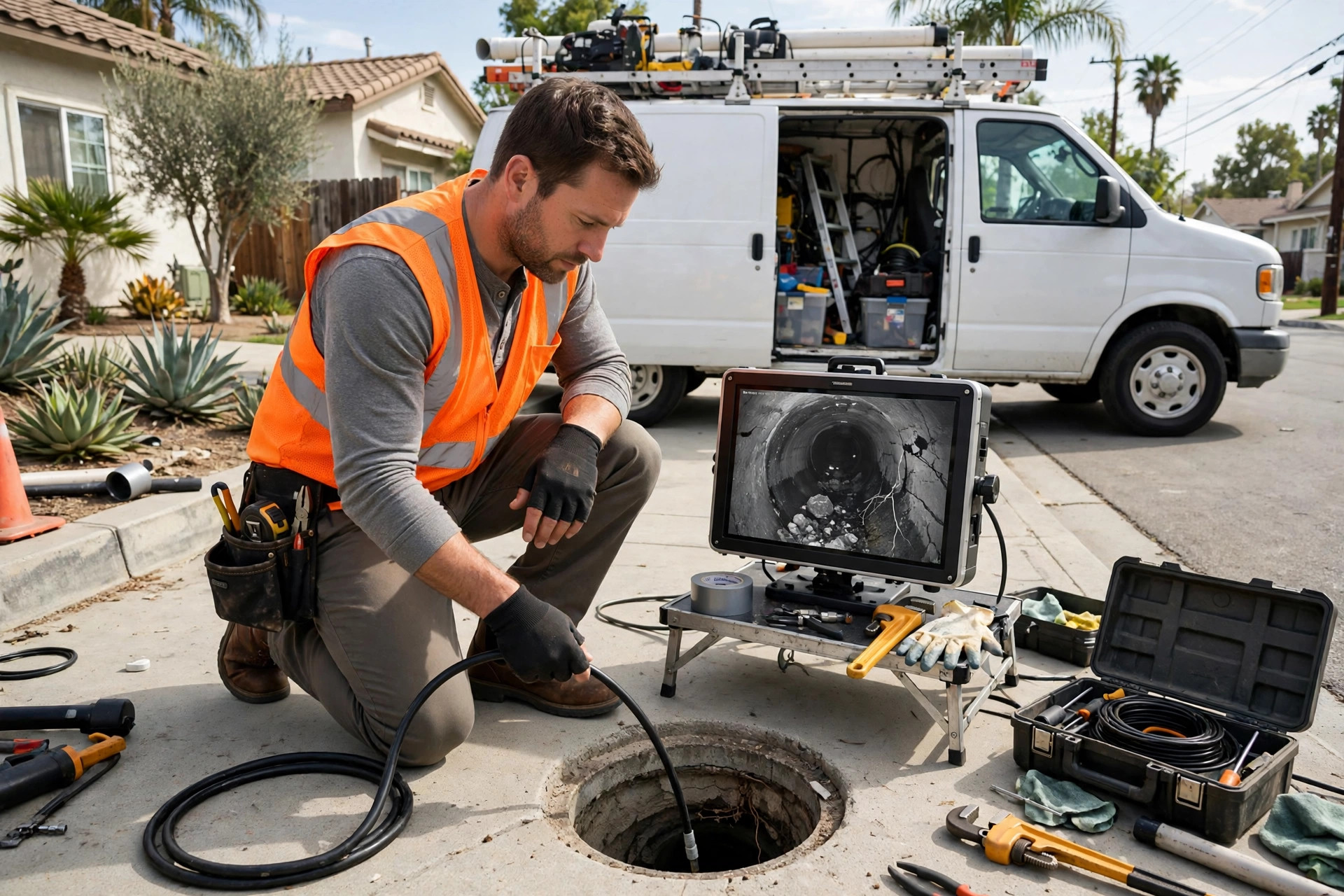
A sewer lateral is the most expensive pipe in a Los Angeles home that nobody ever sees. It runs from the house to the street, beneath yards, driveways, mature trees and sometimes a slab, carrying everything the house drains. When it fails, the symptoms are dramatic: backups, smells, soggy yards and, in the worst case, sewage inside the home. Yet until a camera goes inside that pipe, every diagnosis is a guess based on symptoms, and every repair quote is based on an assumption about what lies underground.
A sewer camera inspection removes that guesswork. A waterproof camera on a flexible cable is fed through a cleanout, recording video as it travels, with a locator above ground tracking its position and depth. The footage shows pipe material, joints, roots, cracks, offsets, bellies where water pools, grease and scale, and the exact distance of each defect from the access point. In a city where clay and cast-iron laterals from different eras sit under oak, sycamore and pepper trees, in expansive soil and on hillsides, that evidence changes decisions about cleaning, spot repair, lining and replacement.
This post explains how a sewer camera inspection works in Los Angeles homes, what it can and cannot show, how to read a report without being misled by a single dramatic image, when to book one, and how the findings connect to the repair choices that follow.
How a sewer camera inspection works in Los Angeles homes
An inspection begins with access. The technician locates a cleanout, usually at the side of the house, in a garage, or near an exterior wall, and confirms that the line can be entered without pulling a toilet or opening a wall. In older Los Angeles homes, a cleanout may be buried, capped with a corroded plug, or absent altogether, in which case the technician will discuss alternative access before starting. Clearing a heavily blocked line first is often necessary, because a camera cannot see through a solid root mat or a pipe full of sewage, and a preliminary cable or jetting pass may be needed to restore enough flow for a clear view.
The camera itself is a small, waterproof head with lights, mounted on a push cable that is fed manually into the line. As it advances, the operator watches a live monitor, notes distances marked on the cable, and records video. A sonde in the camera head emits a signal that a locator receiver above ground can follow, so the technician can mark on the surface where a defect sits and how deep it is. That surface marking matters enormously in Los Angeles, where a defect under a driveway, a mature tree or a slab has very different repair implications from the same defect in open soil.
Los Angeles causes and housing types revealed by the camera
Clay laterals tell a particular story on camera. Built in short sections, clay pipe shows joints every few feet, and the camera reveals joints that have shifted, opened or cracked, allowing roots and groundwater in. A clay lateral under a mature oak may show fine roots at one joint, a thick mat at the next, and a clean section beyond, which maps exactly where trees are affecting the line. The camera also shows whether a clay section has collapsed or lost its alignment, which is a structural finding, not a cleaning problem.
Cast-iron laterals and drains show a different pattern. Corrosion and scale roughen the interior, narrow the bore, and create a surface that catches debris, so the camera may show a pipe that looks smaller than its nominal diameter, with flaking, pitting and tuberculation. In coastal and older Los Angeles homes, cast iron can also show cracks and holes, particularly at the bottom of horizontal runs where water sits. A camera distinguishes a cast-iron line that is rough but sound, and therefore a candidate for cleaning or lining, from one that is perforated and needs replacement.
Housing age and type shape what the camera is likely to find. Homes built between 1948 and 1965 often have laterals from the same era as their galvanized supply systems, so a camera inspection may coincide with supply problems and a broader conversation about system age. Craftsman homes with crawlspaces may have accessible interior drains that the camera can inspect from inside, while Torrance slab homes have laterals that run beneath concrete, so the camera distance and surface locator become the only map for a future spot repair without exploratory cutting. Hillside homes may show laterals with steep grade in one section and a belly in another, where soil movement has changed the original slope.
Signs by room and area: when a camera is warranted
Multiple fixtures backing up at once is the clearest camera signal. When a toilet, a tub and a floor drain all respond to a washing machine discharge, the problem is in a shared or main line, and a camera is the only way to know whether that line is blocked, damaged or both. A single slow sink, by contrast, rarely warrants a full lateral camera, although a branch camera may help if that sink has been cleared repeatedly without lasting improvement.
Recurrence is the second signal. A drain that clogs every few months, a root cleaning that lasts a shorter time each year, or a kitchen line that reclogs weeks after cabling all suggest a structural or coating problem that cleaning alone cannot resolve. A camera after cleaning, when flow is restored and the wall is visible, shows whether the recurrence is due to grease, roots, scale or a belly, and each of those leads to a different plan. Without that footage, recurrence becomes a cycle of paying for the same cleaning without understanding why it fails.
Yard and exterior signs also warrant a camera. A soggy strip over the lateral, unusually lush grass in a line, a cleanout that overflows, or a drain smell near the side of the house after rain can all indicate a lateral leak or break, even if indoor drains still flow. In slab homes, a warm or damp floor patch combined with drain symptoms should prompt both a supply leak check and a lateral camera, because the two systems run in the same hidden space and symptoms can overlap. A home purchase, a major remodel, or a planned driveway or tree planting over the lateral are also sensible camera moments, because they are cheaper before concrete or roots complicate the picture.
Diagnosis steps: from footage to a readable report
A good inspection follows a sequence. The technician first confirms access, line direction and total length, then advances the camera slowly, pausing at each defect to record distance, depth and a clear image. Rushing the camera through a root mat or a greasy section produces blurry footage that hides the very defects the inspection is meant to find. Pausing, adjusting lights, and flushing gently where needed to clear the lens are part of professional technique, not delays.
The report should translate footage into plain language. For each defect, it should state what it is, where it is in feet from the cleanout, how deep it is, how severe it is, and whether it affects flow, structure or both. A root intrusion at 42 feet is different from a root mat that fills the pipe at 42 feet, and a hairline crack is different from a collapsed section. The report should also state the pipe material in each section, because a Los Angeles lateral may change material where a repair or addition was made, and that change affects repair options.
Severity grading needs care. Not every crack requires immediate replacement, and not every root strand requires excavation. A camera report that labels every imperfection as urgent, without distinguishing a minor joint offset from a structural collapse, misleads the homeowner. A useful report separates defects that need immediate action, defects that need planned repair, defects that need monitoring with a future camera, and sections that are sound. That triage is the real value of the inspection, because it turns a long video into a prioritised plan.
What the camera cannot show, and its limits
A camera shows the inside of the pipe, not the soil around it, the condition of the pipe exterior, or the exact cause of a grade problem. A belly, where water pools, is visible as standing water, but the camera alone cannot always tell whether the belly is due to soil settlement, poor original installation, or a broken support. A crack is visible, but the camera cannot measure how much soil has washed into the surrounding ground or whether a void has formed. Those limits mean a camera finding sometimes needs a second check, such as a surface locator survey or a test excavation, before a repair method is finalised.
A camera also cannot see through a fully blocked pipe, a pipe full of water with no flow, or a section that the cable cannot pass. If the camera stops at a collapse or a severe offset, that stop point is itself diagnostic, because it marks the location of a major defect, but the condition beyond it remains unknown until the blockage is cleared or the section is repaired. A report should state clearly where the camera stopped and why, rather than implying that the whole lateral was inspected when only part of it was reached.
Other limits are practical. A camera cannot diagnose supply leaks, water-heater problems, or pressure issues, although it may be booked alongside those checks in a home with multiple symptoms. It cannot guarantee that a lateral will not fail next month, because a pipe that looks sound today can be damaged by future root growth, soil movement or construction. What it can do is record the current condition accurately, so that future change is measurable rather than speculative. Treating a camera report as a snapshot, not a lifetime guarantee, keeps expectations honest.
Repair options the camera evidence supports
When the camera shows a single cracked joint or a short damaged section in an otherwise sound lateral, a spot repair is often the proportionate response. The locator marks the defect on the surface, excavation is limited to that area, and the damaged section is replaced, leaving the rest of the lateral untouched. The trade-off is disruption at that spot, which may be under a driveway, a path or a tree root zone, and the need to protect the new joint from the same root or soil pressure that damaged the old one. A spot repair is only sensible when the camera confirms that the rest of the line is genuinely sound.
When the camera shows damage over a longer run, but the pipe still holds its shape and grade, trenchless lining may be an option. Lining creates a new pipe inside the old one, sealing cracks and joints without a full trench, which is attractive under driveways, mature trees and slab areas. It is not suitable for a collapsed pipe, a severe belly that has lost grade, or a line with major offsets that a liner cannot bridge. The camera evidence, including diameter, grade and the extent of damage, decides whether lining is technically feasible, and a cleaning or jetting pass is usually needed first so the liner adheres to a clean wall.
What to check before calling for a camera inspection
Before calling, gather the symptom history that makes the footage interpretable. Note which fixtures back up, how often, whether rain matters, what previous cleaning found, and whether the problem is new or long-standing. If a previous camera report exists, have it ready, because comparing old and new footage shows change over time, which is more informative than a single inspection alone. Note the location of cleanouts if you know them, and whether any cleanout is buried, damaged or inaccessible, because access determines how much of the lateral can be inspected.
Prepare the area and the household for the visit. Clear access to cleanouts, protect flooring near the entry point, and plan for drains to be out of use briefly during the inspection. If sewage is currently backing up, say so when calling, because the order of work changes: flow must be restored before a clear camera view is possible, and the visit may need to include cleaning as well as inspection. Do not use chemical drain cleaners before the visit, because they remain in standing water and create a hazard when the line is opened, and they do not improve camera visibility.
Decide what you want from the report before the technician arrives. Ask whether you will receive the full recording, a written summary with distances and depths, and a severity triage that separates urgent, planned and monitoring items. Ask whether the inspection will cover the full lateral to the street where access allows, and what happens if the camera cannot pass a blockage. Those questions set the standard for the visit and ensure you leave with evidence you can use, not just a verbal impression.
Prevention and maintenance for Los Angeles laterals
A camera inspection is itself a prevention tool when it is repeated at sensible intervals. For a home with mature oak, sycamore or pepper trees over the lateral, a camera every few years tracks root return and joint deterioration before they become a backup. For a home with a known belly or minor offset, periodic cameras show whether the defect is stable or worsening, which decides whether monitoring remains safe or repair should be scheduled. Keeping recordings with dates creates a lateral health record, much like keeping service records for a water heater.
Prevention also involves what goes into the lateral and what grows over it. Avoiding wipes, sanitary products, grease and excessive food waste reduces the load on a pipe that may already be rough inside. Avoiding planting new large trees directly over a known lateral, and managing irrigation so soil around the lateral does not stay saturated, reduces root and soil pressure. Before winter rain, checking cleanouts, area drains and gutters, and addressing a slow drain in autumn, reduces the chance that a cracked lateral taking in groundwater will fail during a storm.
Hard water and pressure, while primarily supply-side issues, interact with lateral health in older homes. Scale in drains, combined with a rough cast-iron interior, accelerates clogging, so descaling and cleaning intervals matter. Hillside pressure above 80 PSI does not damage a lateral directly, but a home with high supply pressure and an aging lateral is a home with two aging systems, and a camera visit is a good moment to check the broader plumbing picture, including pressure and heater condition, so that a single visit yields a fuller maintenance plan.
City-by-city notes across Los Angeles
Pasadena and Glendale laterals often combine the oldest materials with the hardest water and mature street trees. A camera here frequently shows clay joints with roots, cast-iron sections with scale, and a mix of materials where additions and repairs have changed the pipe over decades. The value of a camera in these neighbourhoods is therefore high, because a symptom that looks like a simple clog may actually be three different defects in one lateral, each needing a different response.
Torrance slab homes make camera evidence especially valuable, because the lateral runs beneath concrete and any repair involves cutting or trenchless work that cannot be planned by guesswork. A camera distance and locator mark allow a spot repair to target a few feet of slab rather than a whole room, and a lining decision to be based on grade and diameter rather than assumption. Torrance laterals under mature landscaping also show root patterns that a camera maps precisely, which matters when a tree cannot simply be removed.
Long Beach and Santa Monica add shared laterals, older apartment plumbing and coastal groundwater. In multi-unit buildings, a camera may need to distinguish a unit branch problem from a shared lateral problem, and coordination with neighbours is part of the diagnosis. Coastal laterals that show inflow staining and sediment at cracks are telling a wet-weather story, and a camera report that notes those signs helps a homeowner understand why a line that drains in summer backs up in winter.
Frequently asked questions
How long does a sewer camera inspection take?
Most residential inspections take well under an hour of camera time once access is established, longer if a blockage must be cleared first or if the lateral is long and complex. The recording and written report, with distances and depths, are part of the service and should be provided to the homeowner.
Will the camera damage my old clay or cast-iron pipe?
A camera is a diagnostic tool, not a cleaning tool, and it is pushed gently through the line. It does not cut, jet or force its way through a collapse. If it cannot pass a severe offset or collapsed section, that stop point itself is useful evidence of a major defect.
What does a belly in a sewer line mean?
A belly is a section that has lost its downhill grade, so water pools there instead of flowing to the street. Sediment and waste settle in the pool, causing slow drains and recurring clogs. Cleaning helps temporarily, but a belly that is severe or worsening usually needs repair to restore grade.
Related service
Call Los Angeles Plumbing Pros
If you are seeing the signs in this post, describe what you see, where it is, and when it started. A technician will talk through the next step before any work starts.