
Water Softener Installation in Los Angeles: Hard Water, Scale, and What Actually Works
Los Angeles Plumbing Pros Blog — 30 Oct 2026
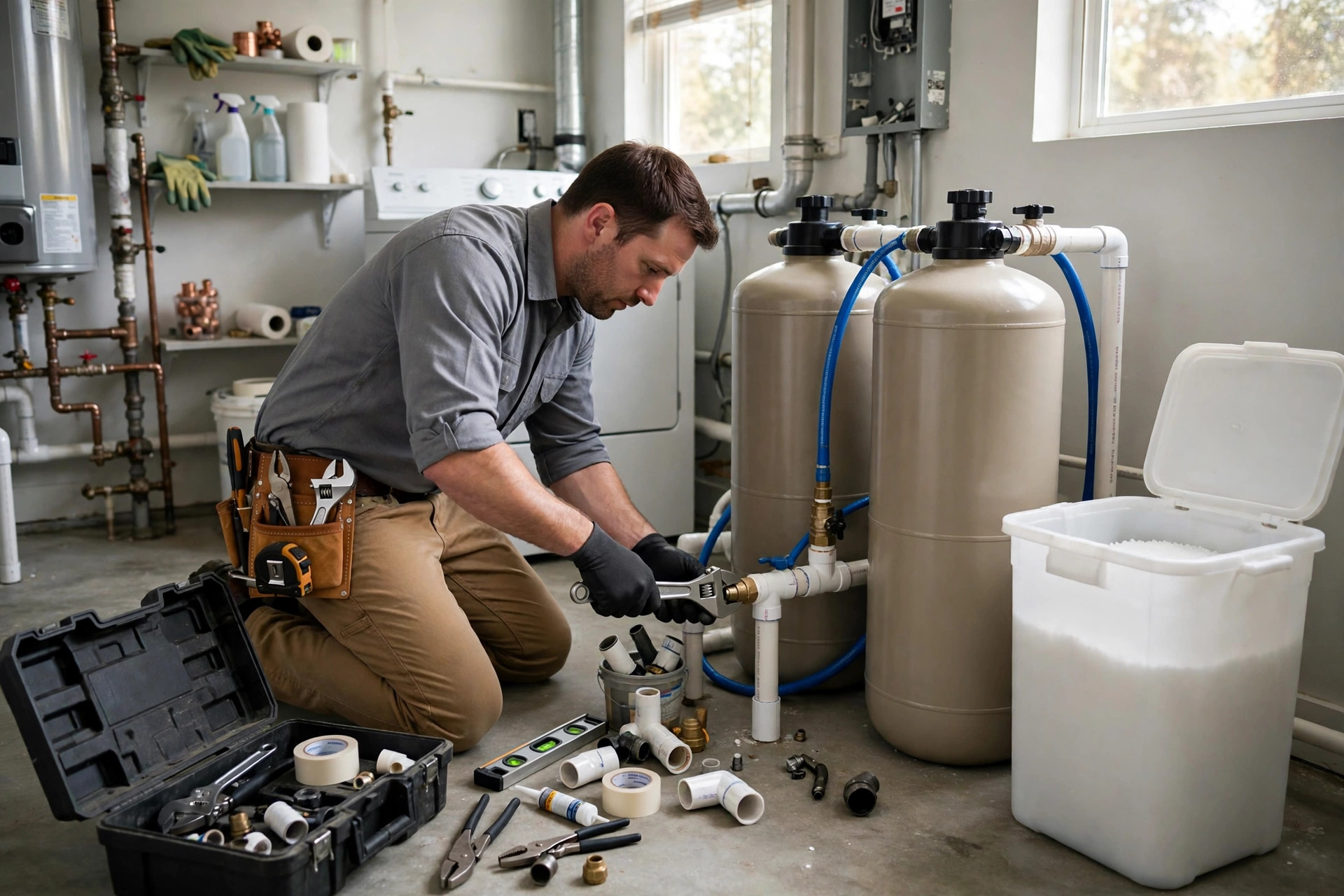
Los Angeles water leaves its mark everywhere it goes. White crust on a showerhead, spots that survive a dishwasher cycle, a water heater that rumbles, and laundry that feels stiff after washing are not separate problems. They are different faces of the same water. Los Angeles water commonly measures 200 to 400-plus parts per million of hardness, and in Glendale it runs over 12 grains per gallon, which is firmly in the very hard range. That hardness is dissolved calcium and magnesium, and a water softener is designed to remove those minerals before they reach your fixtures, your heater, and your pipes.
This post explains how a softener actually works in a Los Angeles home, why hardness hits some houses harder than others, what signs to look for room by room, how hardness and plumbing condition are diagnosed, and how to choose between the main system types without being sold a device that does not match your water, your household size, or your house. It also covers the maintenance that keeps a softener working in Los Angeles conditions, and how the answer changes from Glendale to Santa Monica, from hillside homes to older apartments.
How a water softener works in a Los Angeles home
A conventional salt-based softener uses a tank of resin beads to exchange hardness minerals for sodium. Hard water flows through the resin, calcium and magnesium stick to the beads, and softened water flows out to the house. When the resin is full, the system regenerates: it flushes the beads with a salty brine, washes the trapped hardness down the drain, and recharges the resin for the next cycle. That regeneration is why a softener needs a drain, a water supply, and a regular supply of salt, and why it is usually installed where the main water line enters the house, often in a garage, a utility area, or near the water heater, so that softened water reaches the whole home rather than a single tap.
That whole-house placement matters in Los Angeles because hardness does not only affect drinking water. It affects the shower, the dishwasher, the washing machine, and, most expensively, the water heater, where heat causes minerals to drop out as scale. A point-of-use filter at a kitchen sink can improve taste at that tap, but it will not protect a heater in the garage or a shower valve in a bathroom. A softener, by contrast, treats water before it branches to those fixtures. The trade-off is that a softener is a larger, plumbed appliance with its own maintenance, not a filter you screw on and forget, and its size, regeneration timing, and drain route all need to fit the house and the household's daily water use.
Why Los Angeles water and housing make hardness worse
Hardness in Los Angeles is not uniform. Water sourced and blended from different supplies varies by area and by season, and neighbourhoods such as Glendale, Burbank, and parts of the foothills sit at the hard end of the range, while coastal areas may be somewhat less hard on a given day but still hard enough to scale a heater and spot glassware. That variation means a neighbour's experience is a useful clue but not a measurement. Two houses on the same street can also have different results if one has a softener, a newer heater, or newer piping, and the other has an older system that has been collecting scale for years.
Housing age sharpens the problem. Many Los Angeles homes built between 1948 and 1965 still have sections of galvanized steel piping, which narrows as rust and mineral build up inside. In those pipes, hardness does not just leave spots; it combines with corrosion and sediment to reduce flow, raise pressure at fixtures, and make a water heater work harder. Hillside homes add pressure to the picture, because elevation changes can push household pressure over 80 PSI in some locations, and high pressure plus scale is a harder life for valves, supply lines, and heater components. Older apartments in Santa Monica and Culver City, with shared walls, shared water risers, and older fixtures, face a different version of the same issue: one building's hard water affects many units, and a single-unit solution may not match a building-wide problem.
Signs of hard water by room and area
In the bathroom, start with the showerhead and the glass. White, chalky buildup on a showerhead, a shower door that spots no matter how often it is wiped, and a shower that loses pressure over months as scale narrows its openings are classic hard-water signs. Faucet aerators tell the same story in miniature: unscrew one and look for white crust and grit. In the kitchen, a dishwasher that leaves film on glasses, a kettle that furs up inside, and a faucet that stiffens or drips as mineral builds up in its cartridge are common clues. None of these alone proves you need a softener, but together they show hardness is reaching every fixture.
In the laundry room, hard water makes detergent work less effectively, so clothes can feel stiff, towels lose absorbency, and a washing machine may need more detergent for the same result. In the garage or utility closet, the water heater is the most important sign. Popping or rumbling during heating, a heater that takes longer to recover, and hot water that runs out sooner than it used to all suggest scale inside the tank or, in a tankless unit, inside the heat exchanger. Outside, hose bibs and irrigation valves can crust over as well, and in a home with galvanized piping, a gradual loss of flow at multiple fixtures, rather than a single clogged aerator, points to a system-wide buildup rather than a single fixture problem.
Diagnosis steps: testing hardness and checking the system
Diagnosis should start with a number, not a guess. A hardness test, taken at a tap that is not already filtered or softened, gives a reading in parts per million or grains per gallon and lets you compare your home with the Los Angeles range of 200 to 400-plus parts per million. A test taken after a softener, or at a filtered kitchen tap, will mislead you. It also helps to test at more than one time if the first result is borderline, because Los Angeles supply blends can shift, and a single low reading does not erase months of spotting and scale.
Next, a technician will look at the system the softener would protect. That means checking the main line size and material, the location for a drain and a bypass, household pressure, and the condition of the water heater, including its age, whether it has been flushed, and whether seismic straps and the pressure relief system are in good shape. In a home with 1948 to 1965 galvanized piping, the check will also look for reduced flow, rust-coloured water after the tap has sat overnight, and previous repairs that suggest the piping itself may need attention before or alongside softening. In a hillside home, a pressure reading matters because a softener installed into a system already running over 80 PSI will not fix pressure damage on its own, and a pressure-reducing valve may need to be part of the same conversation.
Softener options and the trade-offs between them
The main choice is between a true salt-based softener and a salt-free conditioner, and the difference is important. A salt-based system actually removes calcium and magnesium through ion exchange, so it reduces scale formation throughout the house. A salt-free conditioner does not remove hardness in the same way; it is designed to change how minerals behave so they are less likely to stick as hard scale, but the water still tests hard, and spots on glassware may remain. For a Glendale home over 12 grains per gallon with a scaled heater, that distinction can decide whether the problem improves or merely changes shape.
Within salt-based systems, size and configuration matter. A single-tank system regenerates at a set time, usually overnight, and during regeneration softened water is briefly unavailable. A dual-tank system can switch to a second tank during regeneration, so a large household that uses water around the clock never runs on hard water, but it takes more space and costs more to install and maintain. Metered systems that regenerate based on actual water use waste less water and salt than timer-only systems in a home whose use varies, which is common in Los Angeles households with guests, rentals, or seasonal use. The trade-off in every case is between upfront space and cost, ongoing salt and water use during regeneration, and how completely and continuously you want hardness removed.
What to check before calling Los Angeles Plumbing Pros
Before calling, note the signs that matter most to you: spotting, scale, heater noise, laundry stiffness, or flow loss, and where each one shows up. Note how many people live in the home, how many bathrooms it has, and whether water use spikes at certain times, because softener sizing depends on household demand, not just hardness. Find the main water shutoff and the area where a softener might go, and check whether that area has a drain nearby, power if the chosen system needs it, and enough clearance for salt to be added and for a technician to service the unit.
It also helps to know what you already have. If there is an existing softener, filter, or tankless heater, note its age and whether it has been serviced, and whether any tap is already filtered. In an older apartment in Santa Monica or Culver City, note whether the problem is building-wide or only in your unit, and who controls the main water supply, because a single-unit softener cannot treat water for a whole building and may need building approval. In a hillside home, mention pressure if you know it, especially if it runs over 80 PSI, and in a home with galvanized piping, mention any rust colour or flow loss, because those facts change whether softening alone is the right first step or whether piping and pressure need to be addressed in the same plan.
Prevention and maintenance in Los Angeles hard water
A softener only protects a home while it is maintained. Salt needs to be checked and topped up before the brine tank runs dry, because a system out of salt is simply passing hard water through. The brine tank itself can develop a salt bridge, a hard crust that looks full from above but leaves the water below untouched, so a visual check that actually probes the salt level matters more than a glance at the lid. Resin, filters, and any pre-filter for sediment should be checked on the schedule for that system, and in Los Angeles homes with older galvanized piping, sediment can be higher than expected, which shortens filter life.
Maintenance should also cover what the softener protects. A water heater that was already scaled before softening will not clean itself just because new scale has stopped forming, so a flush or descale may still be needed, and then the softener protects the cleaned unit going forward. Checking household pressure, keeping seismic straps on the water heater secure, and watching for leaks at the softener's bypass and drain connections are part of the same routine. If you go away for an extended period, ask how the system should be left, because a softener that regenerates on a timer while no one is using water wastes salt and water, while a metered system will largely wait for use. Small, regular checks are what turn a softener from a one-time installation into lasting protection against Los Angeles hardness.
It is also worth keeping a simple record of hardness readings, salt use, and any change in spotting or heater noise, because that record shows whether regeneration is keeping up with your household. If spots return suddenly, check salt and bypass position first, then look for a change in water use, such as guests, a new appliance, or a leak that is driving extra flow through the system. Those clues often explain a softener problem faster than assuming the resin has failed, and they give a technician a clear starting point.
City-by-city notes across Los Angeles
In Glendale, where hardness runs over 12 grains per gallon, softening is often the difference between a heater that scales in a few years and one that holds its efficiency, and the conversation usually starts with heater condition and flow through older piping. Burbank and Pasadena share much of that foothill hardness, with larger homes, more bathrooms, and higher household demand, so sizing and regeneration capacity matter more than in a small flat. In central Los Angeles, the mix of older single-family homes and apartment buildings means a softener decision often follows a piping check, especially in homes built between 1948 and 1965 where galvanized sections are still in service.
Santa Monica and Culver City bring the shared-building question to the front. Older apartments with shared walls and shared risers may need a building-level discussion, and a single-unit system that only treats one kitchen tap will not solve bathroom scale or heater scale for that unit if the rest of the supply is untreated. Long Beach and Torrance, with coastal air and a large post-war housing stock, combine hardness with corrosion on exposed fittings, so outdoor and garage installations need protection from the elements as well as from scale. Hillside neighbourhoods across the city add pressure over 80 PSI to the hardness problem, and in those homes a softener, a pressure check, and a heater check belong in the same visit, because each one affects how long the others last.
Frequently asked questions
Will a water softener make Los Angeles tap water taste different?
It can. Removing calcium and magnesium changes the mineral character of the water, and many people notice softer-feeling water and less spotting. Taste is personal, and some households keep a separate drinking-water filter at the kitchen tap alongside a whole-house softener, which is a common combination in Los Angeles homes.
Does a salt-free conditioner soften water the same way?
No. A conditioner is designed to reduce how readily minerals form hard scale, but it does not remove hardness through ion exchange, so water will still test hard. If your main problem is scale inside a heater and very hard water over 12 grains per gallon, a true softener is the more direct solution.
Will a softener fix a water heater that is already scaled?
A softener stops new scale from forming, but it does not dissolve a thick crust already inside a tank or a tankless heat exchanger. A scaled heater may still need flushing or descaling, and in some cases replacement, after which the softener protects the new or cleaned unit from the same fate.
How much salt and water does regeneration use?
It depends on hardness, household use, and whether the system is metered or timer-based. Metered systems regenerate only after a set volume of water has been softened, so they tend to use less salt and water in a household whose use varies. A technician can estimate use for your hardness and household size once both are known.
Can a softener be installed in an older apartment?
It depends on access to the main supply for that unit, space for the unit and its drain, and building rules. In older apartments in Santa Monica and Culver City with shared risers, a single-unit installation may be impractical, and the building's main supply may need to be considered instead.
Does softening help with galvanized piping?
Softening reduces new mineral scale, which helps, but it does not reverse rust and narrowing inside old galvanized pipe. In homes built between 1948 and 1965, softening is often paired with a piping assessment, because flow loss from corrosion will continue even if hardness is removed.
Related service
Call Los Angeles Plumbing Pros
If spotting, scale, heater noise, or flow loss is showing up in more than one room, describe where it appears, how hard your water tests if you know it, and how many people use water in the home. A technician will talk through the next step before any work starts.